An S-Curve is one of the most well-known and widely used reports on projects. It acts as a road map of project execution. Despite its popularity, many planners still don’t know how to develop it properly, and many Project Managers have no clear idea how to read or analyse it correctly — they simply accept it as long as it has the familiar “S” shape.
Common Practices in S-Curve Development
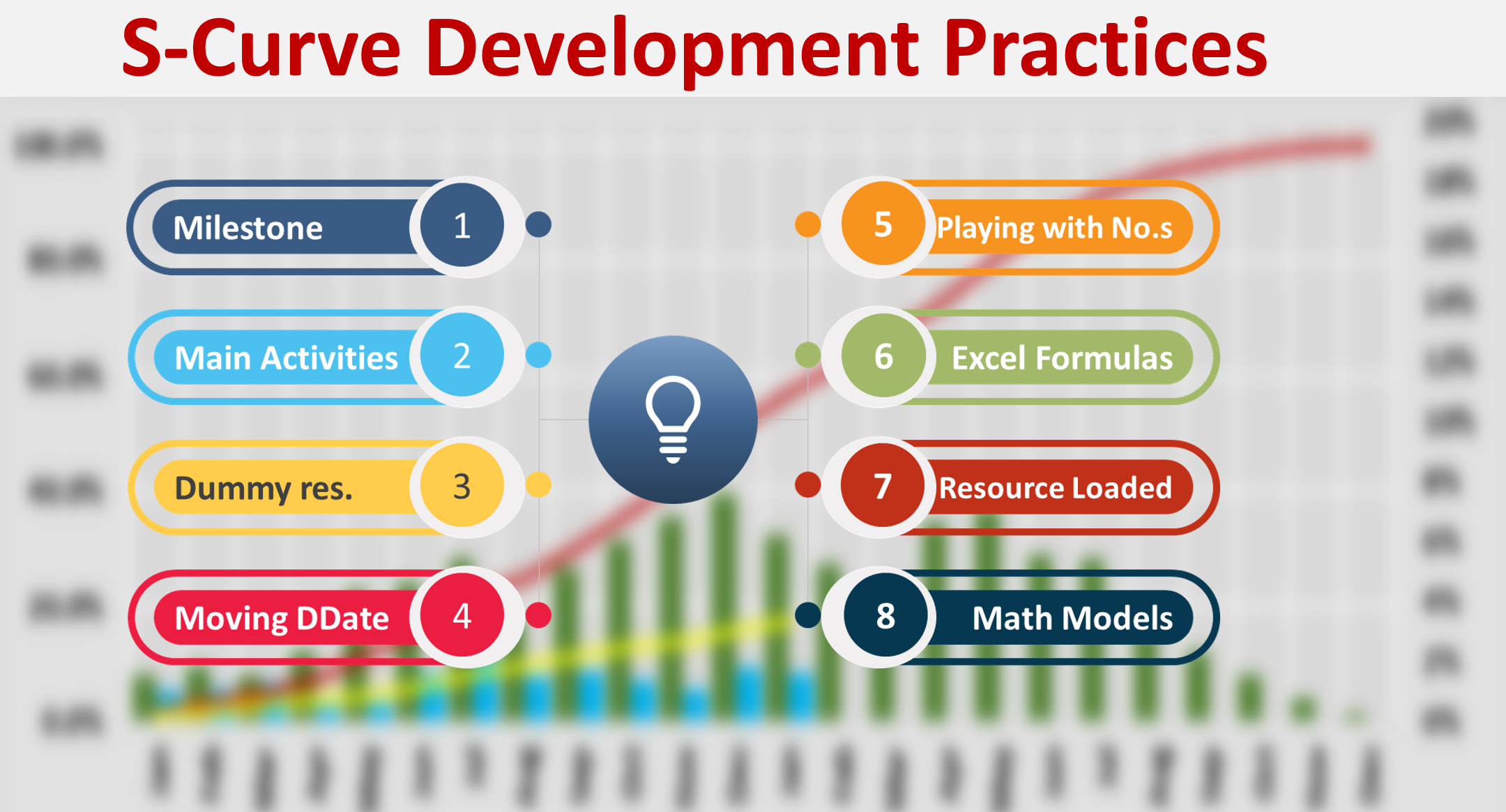
- Based on the project’s (package or phase) milestones.
- Based on the distribution of the cost / man-hours of the main activities list.
- Based on the Duration of activities in the schedule (often called "Dummy resources").
- Moving the data date of the Baseline schedule repeatedly to read progress.
- Arbitrary percentage adjustments in Excel to force an "S" shape.
- Complex mathematical formulas used to "legitimize" incorrect data.
- Based on the resource/cost loaded schedule.
The Risks of Incorrect Practices
Most of the above practices are incorrect. Instead of assisting the Project Manager, they tend to mislead and accelerate project failure. For example:
- Excel-based distributions: Forecast curves are often ignored because the manual update process is too cumbersome.
- Duration-based (Dummy) resources: This reflects a lack of core planning competency. We believe if a planner develops an S-Curve this way, they should be dismissed immediately.
- Manual Data Date shifts: This can take days to complete and usually results in progress based only on Duration%.
The data source for most capital projects must be a Resource Loaded Schedule.
If the road map (S-Curve) is wrong, how can a project be delivered on time and on budget? Many planners remain reluctant to learn proper resource loading, leaving projects with invalid progress metrics.
Master Resource Loading
We provide expert training for capital projects, including Engineering and Construction. Reach out to correct your S-Curve strategy.
Contact Us: info@khonopc.com
Discussion
Very well said Elliott Sir, you are absolutely right many planner Playing such types of game whatever reason ie Company process or system or another one is lack of knowledge..
Leave a Comment