The Consultant’s "Mandate"
There seems to be no limit to incorrect planning procedures, for as we review some, we find weirder practises! The irony is that there is usually no report or analysis indicating the negative impact of these incorrect practises on project failure. Moreover, most of these practises are as per the instructions of a lead planner, client, and consultants. It gets accepted as a reliable source for status reporting and assisting the project team. In this article we will review, how the procurement activities get resource loaded and how it affects the project.
In an EPC project, the planner assigns resources to Engineering and construction activities. Then, he/she leaves the procurement activities without any resources. He presents it to client’s consultant, and the schedule gets rejected. The reason being that the procurement section is not resource loaded! The presented schedule to the client is as follows:
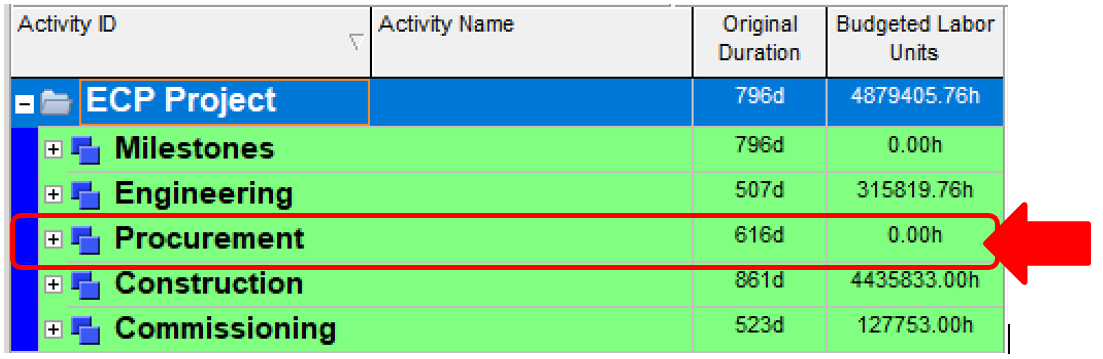
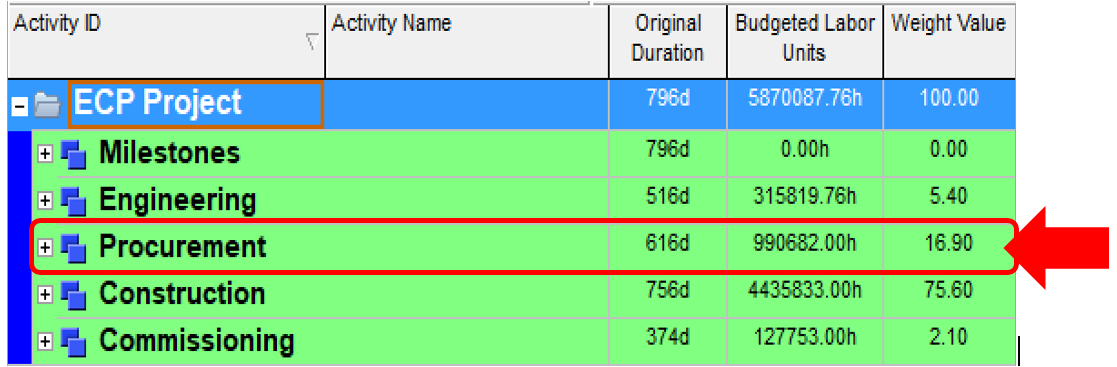
The planner responds would be that there is no detail info (man-hour) available from the vendors, hence he could not assign resources. After back and forth movement, the client’s consultant realizes that vendors will not provide detail info for resource loading. Then he instructs the planner to assign one resource to all the procurement activities and update the budgeted units equal to duration × 8hrs!! Obviously, this is an incorrect practice and demonstrates that the client’s consultant does not know how to deal with procurement activities. The consultant’s argument for this practice is to have procurement progress and S-Curve, then use them for overall project progress and S-Curve!
The Calculation Conflict
This practice creates a mathematical nightmare. While Engineering and Construction units represent Level of Effort (man-hours), the Procurement units now represent Time (Duration).
How can man-hours and duration be combined to develop an overall S-Curve? They cannot, at least not accurately. The resulting progress reports become a mockery of the actual status.
Ignoring the Contract
The irony deepens when we find that contractual weight values—often explicitly defined in the agreement—are ignored entirely in favor of these software "tricks." The schedule data ends up looking nothing like the contractual reality.
Other "Weird" Procurement Practices
- 1- Setting budgeted units equal to the activity duration.
- 2- Assigning a random, identical number (e.g., 2000) to every activity regardless of scope or value.
- 3- Spreading overall procurement cost across activities based solely on their length.
- 4- Assigning cost values to packages when they become available.
Who is Conscious of the Failure?
Stakeholders, management, and even clients are often completely unaware that their status reports are being misled by these incorrect systems. When the project inevitably faces issues, who takes the blame for a system designed to fail?
Discussion
No comments yet. Be the first to share an insight.
Leave a Comment