




17 Nov Man-Hour, Man-Day, Working Hours, Productive Hours
For Resource Loading, the above concepts get used by most Planners. Some planners mix the man-hours with man-day or working hours with productive hours. On certain instances, some planners do not even apply the productive hours in the calculations and assume the resources are productive throughout the day! On the other hand, the project manager / construction managers do like the productive hours and many of them emphasize that the daily/weekly commodity must be planned based on the productive hours.
In this article, we will try to discuss these concepts briefly. 1st let’s review the definition of the concepts.
- In order to load resources on the construction activities, budgeted units should be calculated as per the quantity, norm, then assigned to the activities. The budgeted unit is the man-hour for labor and non-labor.
- Woking hours: is the hours / day that a resource spends on the project. The hours in the project’s calendar (in the software) generally is the same as the working hours.
- Productive hours: are the hours that a resource spends whilst busy working and producing an output. .
Non-productive hours: Toolbox talk hours, lunch break hour, hours for end of the day activities i.e. cleaning up, returning tool to store, etc. Although no work gets produced during these hours but are essential to enable the resource to produce work.
To demonstrate the concepts, we will consider a labor resource for cable laying and is expected to lay 2m per hour and working hours from 6am to 6pm (12 hours) When the non-productive hours get ignored, it means, the resource will lay cable for 12 hours, same as chart below. So at the end of the day, 24m of cable should be layed!
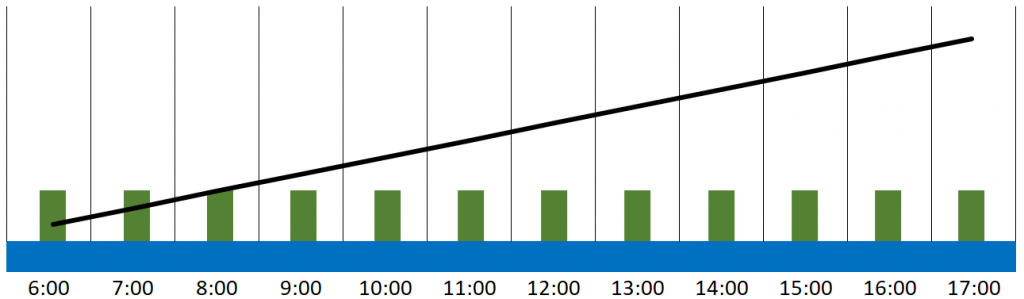
However, the resource does not lay any cable during non-productive hours. As a result, at the end of the day, 18m of cable will be layed.

So, at the end of the day, there is a shortfall of 6m. what will happen to this shortfall? What will happen to the duration of the activities? Some planners argue that they plan per day and the norm is per day (Man-Day) and the resource should produce the 24m regardless of hours spent. This argument is incorrect because:
- The production per day (man-day), must be based on the hours per day. The production in 10 hours/ day will not be the same as 12 hours or 8 hours.
- If the resource gets asked to spend extra hours and complete the shortfall, the question could be asked: for how long will the resource be able to continue to work extra hours? Some Labor / safety rules and regulations do not allow work for more than a certain number of hours per day or per week.
Some construction activities (e.g. RT) requires the site to be evacuated.
So, if resource loading is done as per the Man-Day production rate, most likely the output will be incorrect. moreover, some planners assign the man-day as man-hour in the schedule which again is an incorrect practice.
The Duration of the activities must be based on the productive hours. Because resources get paid for the working hours then working hours should be assigned to the activities.
To know more about resource loading and training, click here
Asiimwe Racheal
Posted at 12:26h, 18 JuneGood research, but like to get an example of calculated productivity showing output and input
admin
Posted at 18:43h, 18 JuneHi Asiimwe, thanks for the comment. To learn the resource loading, we recommend to take our training course. You can find ore detail here: https://khonopc.com/services/training/
Or you could purchase our Resource Loading book, here: https://khonopc.com/product/schedule-resource-loading-guideline-book/
Bud Dunnigan
Posted at 15:33h, 04 Julybuenos dias, excellent blog on lardaceous loss. this helped.